| directory |
| home | contact |
|
|||||||||||||||
| search | |||||||||||||||
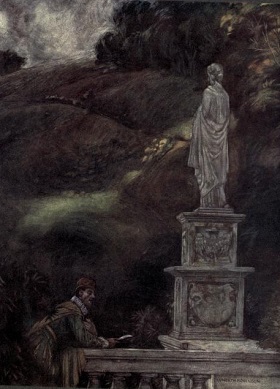
On MalvolioFrom Wit, Humor and Shakespeare. John Weiss.The humor in the play of Twelfth Night resides in the contriving to make one vice ridiculous by other vices which are also absurd. Not one of the comic characters, taken separately, provides the peculiar element of humor. It transpires during the impartial interplay of the silliness of Aguecheek, the drunken techiness of Sir Toby, the spite of Fabian, the mischievousness of Maria, and the immeasurable conceit of Malvolio, who appeared not like a human being, but "as if he were his own statue erected by national subscription." All these vices betray themselves with such an infantile simplicity, and help each other to construct so delightful a plot, that we feel, with the clown, perfectly content to see "foolery walk about the orb like the sun." It is so difficult to discriminate between follies when they protect themselves by being so amusing, that we say with Viola, -- "I hate ingratitude more in a man,We always have, as she did, some vice which we hate worse than others. The one that is damned is generally the only one which would put us to discomfort to practise. But humor can make for a time only those vices companionable which turn a man into his own worst enemy and raise no tragic threat against the State. Malvolio, the steward of Olivia's household, is prized by that lady for his grave and punctilious disposition. He discharges his office carefully and in a tone of some superiority, for his mind is above his estate. At some time in his life he has read cultivated books, knows the theory of Pythagoras concerning the transmigration of the soul, but thinks more nobly of the soul and no way approves that opinion. His gentility, though a little rusted and obsolete, is like a Sunday suit which nobody thinks of rallying. He wears it well, and his mistress cannot afford to treat him exactly as a servant; in fact, she has occasionally dropped good-natured phrases which he has interpreted into a special partiality: for Quixotic conceits can riot about inside of his stiff demeanor. This proneness to fantasy increases the touchiness of a man of reserve. He can never take a joke, and his climate is too inclement to shelter humor. Souls must be at blood-heat, and brains must expand with it like a blossom, before humor will fructify. He wonders how Olivia can tolerate the clown. "I protest," he says, "I take these wise men, that crow so at these set kind of fools, to be no better than the fools' zanies." Olivia hits the difficulty when she replies, "Oh, you are sick of self-love, and taste with a distempered appetite." Perhaps he thinks nobly of the soul because he so profoundly respects his own, and carries it upon stilts over the heads of the servants and Sir Toby and Sir Andrew. Imagine this saturnine and self-involved man obliged to consort daily with Sir Toby, who brings his hand to the buttery-bar before breakfast, and who hates going to bed "as an unfilled can," unless no more drink is forthcoming; an irascible fellow, too, and all the more tindery because continually dry. He has Sir Andrew Aguecheek for a boon companion, who says of himself that sometimes he has no more wit than a Christian, or than an ordinary man. When he is not in liquor he is fuddled with inanity, and chirps and skips about, deluding himself with the notion that Olivia will receive his addresses. Sir Toby, to borrow money of him, fosters the notion, and flatters his poor tricks. Then there is that picador of a clown, who plants in Malvolio's thin skin a perfect quickset of barbed quips, and sends him lowering around the mansion which these roisterers have turned into a tavern. The other servant, Fabian, has a grudge against him for interfering with a bear-baiting he was interested in; for Malvolio was one of those Puritans who frowned upon that sport, as Macaulay said, not because it worried the bear but because it amused the men. The steward was right when he informed this precious set that they were idle, shallow things, and he was not of their element. No doubt he is the best man of the lot. But he interrupts their carousing at midnight in such a sour and lofty way that we are entertained to hear their drunken chaffing, and we call to Maria for another stoup, though they have had too much already; but a fresh exposition of dryness always sets in when such a virtue as Malvolio's tries to wither us. However, he becomes the object of their animosity, and they work in his distemper to make him ridiculous. There is no humor in seeing Malvolio fall so easily a prey to their device. When a man becomes the cause of his own mortification, it is simply comic. But the intrigue becomes humorous when his vice shows disgust at theirs, and theirs becomes indignant at his, and they are delighted to see it well ventilated. For so do we revenge ourselves upon each other, using not our strength which would be tragic, but our weaknesses. Then impartial justice is obliged to smile to see these counterplots of folly further its great plan. What economy it is to have individuals so contrived that they can baffle, mortify, and school each other without importing the constable! We are self-acting arrangements to relieve the universe from tax and keep its hilarity replenished. In this genial manner " the whirligig of time brings in his revenges." Even if we do not lie in wait for each other, the knowledge of mutual frailties gives our whole life a sub-taste of humor; and that leaves respect upon the tongue. Sebastian says to the clown: "I prithee vent thy folly somewhere else." Mankind makes the clown's answer: "Vent my folly! He has heard that word of some great man, and now applies it to a fool. Vent my folly! I am afraid this great lubberly world will prove a cockney." No fear of that, my "corrupter of words;" so long as perfect discretion is unknown upon the earth, we are all cosmopolites of infirmity and speak the great language of smiles. But the play does not let Malvolio drop softly on his feet. There is a faint grudge provoked by the ill-tempered quality of his conceit, and Shakespeare indicates this trait of our nature. The clown, who remembers how the steward used to twit Olivia's contentment at his sallies, and to deprecate it in a lofty way, now mimics his phrases and manner to sting him with a last fluttering dart. Malvolio's pride is already too deeply wounded, for he has indeed been "notoriously abused." There is no relenting in such a man on account of the fun, for that is a crime in the eyes of a Puritan, to be punished for God's sake. His temper acquires sombreness from his belief that total depravity is a good doctrine if you can only live up to it. But when this crime of fun is perpetrated against the anointed self-esteem of the Puritan himself, it is plain he will be revenged on the whole pack of them unless they proceed to make a sop of deference to touch his hurt with, and a pipe out of his own egotism for sounding a truce. Shakespeare delighted to mark the transition of a virtue to a vice; that elusive moment, as of a point of passage from one species to another, discovered and put into a flash from the light of humor. Malvolio's grave and self-respecting temperament is an excellence. No decent man thinks meanly of himself, and the indecent ones cannot afford the disparagement. The pretence of it is a warning to us to expect mischief, a notice put up, "This is a private way; dangerous passing." Whatever gift a man has becomes a divine permission for self-consideration. Modesty is the humanity of a great mind, a vapor which the sun instinctively gathers to make itself tolerable. How to cite this article: |
 More to Explore Twelfth Night: The Complete Play with Explanatory Notes Types of Shakespearean Comedy On the Nature of Shakespearean Comedy Shakespeare's Second Period: Exploring Twelfth Night Twelfth Night: Plot Summary Introduction to Shakespeare's Feste
Spiritual Grace: An Examination of Viola from Twelfth Night
The Comic Relief of Sir Toby Belch and Sir Andrew Aguecheek
Introduction to Shakespeare's Olivia
Introduction to the Duke in Twelfth Night Twelfth Night: Q & A
How to Pronounce the Names in Twelfth Night
Shakespeare and Music Shakespeare's Reputation in Elizabethan England Shakespeare's Impact on Other Writers Why Study Shakespeare? Shakespeare's Boss: The Master of Revels
The Chronology of Shakespeare's Plays
Establishing the Order of the Plays How Many Plays Did Shakespeare Write? Shakespeare Timeline Words Shakespeare Invented Quotations About William Shakespeare Portraits of Shakespeare Top 10 Shakespeare Plays Shakespeare's Metaphors and Similes Shakespeare's Blank Verse Edward Alleyn (Actor) Twelfth Night: The Complete Play with Explanatory Notes Types of Shakespearean Comedy On the Nature of Shakespearean Comedy Shakespeare's Second Period: Exploring Twelfth Night Twelfth Night: Plot Summary Introduction to Shakespeare's Feste
Spiritual Grace: An Examination of Viola from Twelfth Night
The Comic Relief of Sir Toby Belch and Sir Andrew Aguecheek
Introduction to Shakespeare's Olivia
Introduction to the Duke in Twelfth Night Twelfth Night: Q & A
How to Pronounce the Names in Twelfth Night
Shakespeare and Music Shakespeare's Reputation in Elizabethan England Shakespeare's Impact on Other Writers Why Study Shakespeare? Shakespeare's Boss: The Master of Revels
The Chronology of Shakespeare's Plays
Establishing the Order of the Plays How Many Plays Did Shakespeare Write? Shakespeare Timeline Words Shakespeare Invented Quotations About William Shakespeare Portraits of Shakespeare Top 10 Shakespeare Plays Shakespeare's Metaphors and Similes Shakespeare's Blank Verse Edward Alleyn (Actor) |
©1999-2021 Shakespeare Online. All Rights Reserved.