| directory |
| home | contact |
|
|||||||||||||||
| search | |||||||||||||||
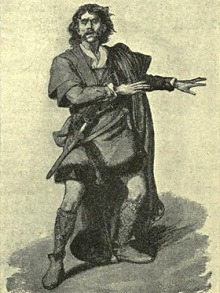
Macbeth's Soliloquy: She should have died hereafter... (5.5.17-28).CommentaryIn this final soliloquy we uncover the ultimate tragedy of Macbeth. "It is the tragedy of the twilight and the setting-in of thick darkness upon a human soul" (Dowden 66). Macbeth's heinous acts throughout the play have resulted in his last, horrible conclusion about life: it is utterly meaningless. Our days on this earth serve no purpose other than to thrust us toward "dusty death." Life is a seemingly endless and depressing succession of bleak days creeping along at a "petty pace." Our time on this earth is so unsubstantial that it can only be compared to a shadow; so unreal that it can only be compared to a stage on which frets a pitiful actor. When the play is over his character disappears into nothingness, and has left nothing significant behind. For more on the metaphors in this final soliloquy and in the play in general, please see my article, Biblical Imagery in Macbeth. Macbeth's feelings toward Lady Macbeth in this soliloquy are not as clear as the overlying theme. As seen in the annotations, there are four, and possibly several more, opinions regarding Macbeth's initial reaction when he hears that his wife is dead. Those who take the first line to mean "she would have died at sometime, either now or later" usually argue that it illustrates Macbeth's callous lack of concern for Lady Macbeth. However, it seems more likely that the line is a combination of meanings (1) and (4) cited in the annotations: [Macbeth] has said (in Scene III of this act) that the battle will cheer him ever after or disseat him now. Up to this time he had expected to win the battle; he was ready to laugh the siege to scorn when interrupted by the cry of women. And may not his visionary thought have pictured the victory as restoring him to the man he once was? He pauses on the word "hereafter" (there are two missing feet in the meter), and realizes that the time will never come now. Sadly he reflects that if it could have been, if he could have gone back, then there would have been time to consider that word, death, and to mourn properly. But now, now that there is to be no victory, and no going back, now that she is gone the tomorrows creep on with their insignificant slow pace to the last syllable of recorded time. (Coles 269-79) Questions for Review 1. How has Macbeth changed since his last soliloquy? 2. Why does Macbeth find fault with Lady Macbeth's dying? 3. How does this soliloquy show that the true tragedy of Macbeth lies not in the violent deaths of the characters, but in the world-view of Macbeth? 4. How do you feel about Macbeth at this point in the drama? Do you pity him? Do you admire him? Back to Soliloquy Annotations How to cite this article:________ Even More  Shakespeare's Workmanship: Crafting a Sympathetic Macbeth Origin of the Weird Sisters Temptation, Sin, Retribution: Lecture Notes on Macbeth Alchemy and Astrology in Shakespeare's Day Characteristics of Elizabethan Tragedy
Why Shakespeare is so Important Shakespeare's Language Shakespeare's Influence on Other Writers Daily Life in Shakespeare's London Life in Stratford (structures and guilds) Life in Stratford (trades, laws, furniture, hygiene) Stratford School Days: What Did Shakespeare Read? Games in Shakespeare's England [A-L] Games in Shakespeare's England [M-Z] An Elizabethan Christmas Clothing in Elizabethan England Queen Elizabeth: Shakespeare's Patron King James I of England: Shakespeare's Patron The Earl of Southampton: Shakespeare's Patron Going to a Play in Elizabethan London Ben Jonson and the Decline of the Drama Publishing in Elizabethan England Shakespeare's Audience Religion in Shakespeare's England Entertainment in Elizabethan England London's First Public Playhouse Shakespeare Hits the Big Time Shakespeare's Workmanship: Crafting a Sympathetic Macbeth Origin of the Weird Sisters Temptation, Sin, Retribution: Lecture Notes on Macbeth Alchemy and Astrology in Shakespeare's Day Characteristics of Elizabethan Tragedy
Why Shakespeare is so Important Shakespeare's Language Shakespeare's Influence on Other Writers Daily Life in Shakespeare's London Life in Stratford (structures and guilds) Life in Stratford (trades, laws, furniture, hygiene) Stratford School Days: What Did Shakespeare Read? Games in Shakespeare's England [A-L] Games in Shakespeare's England [M-Z] An Elizabethan Christmas Clothing in Elizabethan England Queen Elizabeth: Shakespeare's Patron King James I of England: Shakespeare's Patron The Earl of Southampton: Shakespeare's Patron Going to a Play in Elizabethan London Ben Jonson and the Decline of the Drama Publishing in Elizabethan England Shakespeare's Audience Religion in Shakespeare's England Entertainment in Elizabethan England London's First Public Playhouse Shakespeare Hits the Big Time
|
More to Explore Macbeth: The Complete Play with Annotations and Commentary The Metre of Macbeth: Blank Verse and Rhymed Lines Macbeth Character Introduction Metaphors in Macbeth (Biblical) Figures of Speech in Macbeth The Three Apparitions in Macbeth Supernatural Solicitings in Shakespeare Shakespeare on Omens Macbeth, Duncan and Shakespeare's Changes Contemporary References to King James I in Macbeth The Royal Patent that Changed Shakespeare's Life Soliloquy Analysis: If it were done when 'tis done (1.7.1-29) Soliloquy Analysis: Is this a dagger (2.1.33-61) Soliloquy Analysis: To be thus is nothing (3.1.47-71) Soliloquy Analysis: She should have died hereafter (5.5.17-28) Explanatory Notes for Lady Macbeth's Soliloquy (1.5) The Psychoanalysis of Lady Macbeth (Sleepwalking Scene) Is Lady Macbeth's Swoon Real? Explanatory Notes for the Witches' Chants (4.1) Macbeth Plot Summary (Acts 1 and 2) Macbeth Plot Summary (Acts 3, 4 and 5) How to Stage a Production of Macbeth (Scene Suggestions) A Comparison of Macbeth and Hamlet The Effect of Lady Macbeth's Death on Macbeth The Curse of Macbeth On the Knocking at the Gate in Macbeth Macbeth Q & A Essay Topics on Macbeth Aesthetic Examination Questions on Macbeth What is Tragic Irony? Stages of Plot Development in Macbeth Time Analysis of the Action in Macbeth Macbeth Study Quiz (with detailed answers) Quotations from Macbeth (Full) Top 10 Quotations from Macbeth |
 "There is a magic in the expression "brief candle" which I have never known any one to deny. What is the secret of it? A candle is a commonplace enough object; in itself it is not a poetical thing; it is something useful, something with regard to which the idea of use and ownership naturally arises; it stands low down, as an inanimate thing, on the scale of images which culminates in man. Yet, as Shakespeare has used it, it is a central image in a consummate bit of poetry. What has he done to give it such distinctive worth? He has personalised. Here lies the main secret of the worth of this expression." Arthur Fairchild.
 ©1999-2021 Shakespeare Online. All Rights Reserved.