| directory |
| home | contact |
|
|||||||||||||||
| search | |||||||||||||||
MacbethPlease see the bottom of the page and the highlighted text for full explanatory notes and helpful resources.
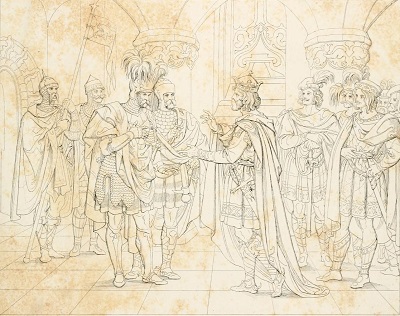
Next: Macbeth, Act 1, Scene 5 ___________ Explanatory notes below for Act 1, Scene 4 From Macbeth. Ed. Thomas Marc Parrott. New York: American Book Co. (Line numbers have been altered.) __________ This scene is supposed to be laid in the royal palace at Forres. The time is perhaps on the morning after the events recorded in the previous scenes. The chief purpose of the scene is to bring Macbeth and Duncan together and, by showing the touching gratitude of the old monarch toward his chief warrior, to give us a double sense of the wickedness of the crime which Macbeth is already meditating against his sovereign. Two incidents in the scene contribute directly to the perpetration of this crime. The first of these is Duncan's proclamation of his son, Malcolm, as heir to the throne. So long as no heir was named it was possible for Macbeth to wait patiently, hoping that at the king's death, which could not be far distant, he might be chosen as his successor. But the nomination of Malcolm implied that all the nobles must take an oath to support his succession to his father's throne; and thus Macbeth feels that it will no longer be possible to wait for chance to crown him. If he is to be king at all, he must make himself king. The second incident is Duncan's sudden resolve to visit Macbeth's castle. This step puts him into Macbeth's hands and offers such an opportunity for the murder as may not occur again. Macbeth realizes this, and under pretense of hurrying home to make preparation for the king, departs to consult with his wife as to what should be done. 2. Those in commission, the committee of nobles entrusted with the execution of Cawdor. It was common in Shakespeare's day to intrust the trial of important personages to a special commission. 6. set forth, declared. 9. studied. The phrase is, perhaps, taken from the technical language of the theatre. Cawdor played his part on the scaffold like an actor who has studied his part well; he had, so to speak, rehearsed his death. 10. owed, owned. 11. careless, worthless. 11-14. There's ... trust. Note the tragic irony of the situation. Duncan is lamenting that he had been so deceived in Cawdor. At this moment Macbeth enters, and Duncan turns to greet this far more dangerous enemy with a glad welcome. 14. A foot is wanting in this line. The lack is due to the pause on Macbeth's entrance. 18-20. Would ... mine! I wish that you had done less for me so that I might be able to thank and pay you proportionately. 22-27. The service, etc. We should not consider this speech of Macbeth as a pure piece of hypocrisy. He has, indeed, contemplated the possibility of murdering Duncan, but he has decided to wait and trust to chance. And now, at the affectionate welcome of the old king, his natural impulse of loyalty breaks out, and, for the time at least, he means what he says. 27. Safe toward, with a sure regard to. 34. Wanton in fulness, capricious because they are full. 35. drops of sorrow, tears. There is something very pathetic in the figure of the good old king weeping for very joy as he stands between the two warriors, one of whom is to murder him and the other to let the murder go unrevenged. 36. whose places are the nearest, who are next to the king in rank. 37. establish our estate, settle the succession to the throne. 39. Prince of Cumberland, Cumberland, a county in the northwest of England, was for a long time held by the Scotch under the suzerainty of England. The title. Prince of Cumberland, like that of Prince of Wales today, served to distinguish the heir to the throne. 39, 40. which ... only. He, Malcolm, must not be the only man to be invested with a new title of honour. 42. Inverness, a town in Scotland, some twenty or twenty-five miles from Forres. Macbeth is supposed to have had a castle here, and as a mark of royal favour Duncan now proposes to visit him. 43. bind us further to you, lay us under still greater obligations to you, i.e. by acting as our host at Inverness. 44. the rest, etc. The leisure time which is not spent in your service is no leisure, but rather labour. It may be that this stilted compliment marks the agitation of Macbeth's mind. We see a few lines below that he has resumed his plan of the murder. 45. harbinger, originally a messenger sent ahead to provide a lodging for a king on his travels. 47. My worthy Cawdor. Duncan bids farewell to Macbeth by his new title and then turns to Banquo. This gives Macbeth an opportunity before he leaves the stage for the 'aside' of lines 48-53. This 'aside,' it should be noted, represents the thoughts that are passing through Macbeth's mind, rather than any words actually spoken. 48-53. The Prince ... see, Macbeth realizes that the naming of Malcolm as heir-apparent leaves him no other choice than that between renouncing his ambition or taking violent action to realize it. He is by no means disposed to abandon his hopes of the crown, and instantly his heart is filled anew with "black and deep desires," which he fears to expose to the light. 52. The eye wink at the hand, let the eye refuse to see what the hand is doing. It is as if Macbeth already saw himself stabbing the king, and wished to close his eyes to the sight. 54. he is full so valiant, he is quite as brave as you say. Banquo seems to have been telling Duncan of some brave deed of Macbeth. 57. Whose care. Macbeth's carefulness for the king's welfare is here personified by the kindly monarch, and thought of as a harbinger riding ahead to prepare a welcome for him. ________ How to cite the explanatory notes:________ More Resources  The Chronology of Shakespeare's Plays
Establishing the Order of the Plays How Many Plays Did Shakespeare Write? Shakespeare Timeline Shakespeare's Reputation in Elizabethan England Words Shakespeare Invented Quotations About William Shakespeare Portraits of Shakespeare Shakespeare's Boss: The Master of Revels Top 10 Shakespeare Plays Shakespeare's Metaphors and Similes Shakespeare's Blank Verse Shakespeare Timeline Edward Alleyn (Actor) What is Tragic Irony? Characteristics of Elizabethan Tragedy The Chronology of Shakespeare's Plays
Establishing the Order of the Plays How Many Plays Did Shakespeare Write? Shakespeare Timeline Shakespeare's Reputation in Elizabethan England Words Shakespeare Invented Quotations About William Shakespeare Portraits of Shakespeare Shakespeare's Boss: The Master of Revels Top 10 Shakespeare Plays Shakespeare's Metaphors and Similes Shakespeare's Blank Verse Shakespeare Timeline Edward Alleyn (Actor) What is Tragic Irony? Characteristics of Elizabethan Tragedy
|
More to Explore Macbeth: The Complete Play with Commentary The Metre of Macbeth: Blank Verse and Rhymed Lines Macbeth Character Analysis Figures of Speech in Macbeth Metaphors in Macbeth (Biblical) The Theme of Macbeth Is Macbeth the Third Murderer? Macbeth, Duncan and Shakespeare's Changes King James I and Shakespeare's Sources for Macbeth Contemporary References to King James I in Macbeth The Royal Patent that Changed Shakespeare's Life Soliloquy Analysis: If it were done when 'tis done (1.7.1-29) Soliloquy Analysis: Is this a dagger (2.1.33-61) Soliloquy Analysis: To be thus is nothing (3.1.47-71) Soliloquy Analysis: She should have died hereafter (5.5.17-28) Differences Between Macbeth and Lady Macbeth Explanatory Notes for Lady Macbeth's Soliloquy (1.5) The Psychoanalysis of Lady Macbeth (Sleepwalking Scene) Is Lady Macbeth's Swoon Real?
Explanatory Notes for the Witches' Chants (4.1) Macbeth Plot Summary (Acts 1 and 2) Macbeth Plot Summary (Acts 3, 4 and 5) How to Stage a Production of Macbeth (Scene Suggestions) A Comparison of Macbeth and Hamlet The Effect of Lady Macbeth's Death on Macbeth The Curse of Macbeth
Shakespeare's Sources for Macbeth Macbeth Q & A Essay Topics on Macbeth Aesthetic Examination Questions on Macbeth What is Tragic Irony? Stages of Plot Development in Macbeth Time Analysis of the Action in Macbeth Macbeth Study Quiz (with detailed answers) Quotations from Macbeth (Full) Top 10 Quotations from Macbeth Crafting a Sympathetic Macbeth The Moral Character of Macbeth Origin of the Weird Sisters Temptation, Sin, Retribution: Lecture Notes on Macbeth Untie the winds: Exploring the Witches' Control Over Nature Characteristics of Elizabethan Tragedy
Why Shakespeare is so Important Shakespeare's Language Shakespeare's Influence on Other Writers |
 "The character of Macbeth, as presented in the play, is a progressive one. As the plot proceeds his few good qualities disappear, while the evil become more and more developed. His career is a downward one. He goes from good to bad, and from bad to worse." Kenneth Deighton.
 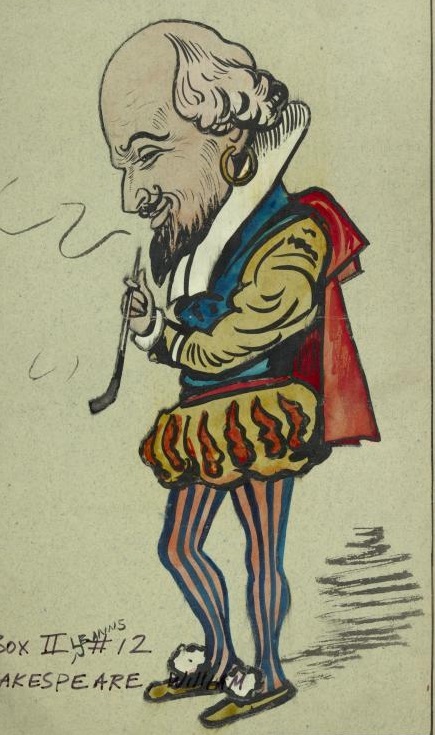 Richard Shakespeare, Shakespeare's paternal grandfather, was a farmer in the small village of Snitterfield, located four miles from Stratford. Records show that Richard worked on several different farms which he leased from various landowners. Coincidentally, Richard leased land from Robert Arden, Shakespeare's maternal grandfather.
 ©1999-2021 Shakespeare Online. All Rights Reserved.