| directory |
| home | contact |
|
|||||||||||||||
| search | |||||||||||||||
MacbethPlease see the bottom of the page and the highlighted text for full explanatory notes and helpful resources.
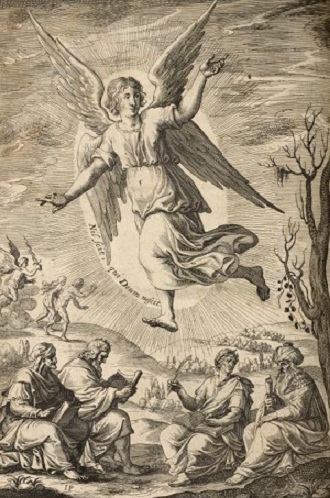
Next: Macbeth, Act 2, Scene 1 _______ Explanatory notes below for Act 1, Scene 7 From Macbeth. Ed. Thomas Marc Parrott. New York: American Book Co. (Line numbers have been altered.) __________ This is perhaps the most important single scene of the play. Here for the last time we see Macbeth a free man, still capable of choice between good and evil. The motives that are at work to deter him from committing the murder, fear of the consequences in this world, mingled feelings of kinship, loyalty, and hospitality, admiration for Duncan's goodness, are not, perhaps, of the highest moral character; but in comparison with the reckless lust of power which urges him on, they are certainly motives for good. The conflict rages in his soul, and it seems as if the powers of good were triumphing, when Lady Macbeth enters. Instantly she throws into the scale all the weight of her influence, backed by a relentless decision to contemplate nothing but the immediate necessity for action. Macbeth wavers for an instant, and then, not so much overpersuaded, as stung into action by the taunts of his wife, plunges headlong into the crime. From this time till the end of the play Macbeth is no longer a free man. All his remaining actions spring by the logical necessity of crime from his first deed of blood. * Sewer, chief butler. 1. Note the double meaning of "done" in this line: in the first instance it means "finished," in the second "performed." Macbeth's meaning, which he goes on to illustrate through the next seven lines, is that if the whole matter could be settled by one blow, it would be well to strike that blow quickly. 4. his surcease, its cessation. "His" is generally used instead of the modern "its" in Shakespeare. The antecedent is probably "consequence" in the preceding line. The passage may be paraphrased thus: "If the murder could ensnare the consequences, so as to prevent them from occurring, and by stopping them catch success, it would indeed be well to act quickly." 4. that but this blow, if just this blow. 6. But here, only here. 8. that, because. 8. have judgement here, receive our sentence in this life. 9. Bloody instructions, lessons in bloodshed. 11. commends, presents. 14. Strong both, both strong arguments. 17. faculties, royal perogatives. 18. clear, blameless. 21. pity. In this passage where the wild emotions of Macbeth's mind are struggling for utterance, one metaphor crowds upon and displaces another. "Pity" is first personified as a newborn infant, naked and miserable, such as would appeal to the sympathy of all men; then this infant bestrides the wind for a charger to carry the news of Duncan's murder throughout the world. This figure of a messenger seated upon the wind calls up a confused memory of a verse of the Bible (Psalms, xviii. 10.) to Macbeth's mind, and his imagination embodies pity as an angel riding on the wind. 22. cherubim, [originally cherubin - please click on word above for explanation]. 23. sightless couriers of the air, invisible airy messengers, the winds. The angel is represented like a royal messenger riding post, i.e. changing from horse to horse to carry his message the faster. See Textual Notes, p. 252. 24. blow the horrid deed in every eye, proclaim the murder in the presence of all men. 25. That, so that. 25. tears shall drown the wind. The figure is taken from a burst of rain which lays the wind. 25. I have no spur. Here again we have a mixture of metaphors due to the conflict of emotions in Macbeth's mind. He thinks of his purpose to murder Duncan as a charger; but he has no spur, i.e. no good motive, to urge it into action and so it stands still. Instantly the figure changes and his ambition is pictured as a rider springing into his saddle, who overleaps himself and falls on the other side of his steed. Macbeth means that his ambition to be king would, if it led him to murder Duncan, carry him too far. 28. An accented syllable is missing in the third foot. Some editors have wished to supply "side"; but it is better to think of the speech as interrupted by the entrance of Lady Macbeth. 29. Why have you left the chamber? Macbeth, conscious of his guilty wish, has been unable to remain in the presence of his benefactor. Duncan has noticed his absence and asked for him. Lady Macbeth, under the pretense of recalling him to the banquet, comes to confirm him in his purpose. Her speeches in this scene should be most carefully studied. A careful analysis of them will show how she plays upon Macbeth's feelings and appeals to the strongest motives. She taunts him first with irresolution and lack of love for her. She charges him with cowardice, — the bitterest possible charge for a soldier to endure from the woman he loves. She appeals to him to keep the vow he has sworn, and declares that she would have stopped at no crime if she had taken such an oath. Finally seeing that the chief, perhaps the only, cause that holds Macbeth back from the deed is a fear, not only of failure in the attempt, but of the consequences in case of its accomplishment, she points out a plan by which the murder may be safely committed and the consequences shifted upon the shoulders of others. 32. bought, gained. 34. would be worn, should be, ought to be, worn. 35. cast aside, as they would be if Macbeth exchanged his fame as a warrior for a murderer's infamy. 35, 36. drunk ... dressed yourself, another mixture of metaphors. "Hope" is first presented as a person intoxicated with the prospect of success, and then a robe in which Macbeth arrayed himself. The latter figure is caught from his own phrase of "wearing" golden opinions" in the preceding speech. 37. green and pale, sickly and pale, as a man might look on waking from a drunken slumber. 38. At what it did so freely, at what it, i.e., "hope," faced so boldly before it fell asleep. 39. Such, so "green and pale"; i.e. so sickly and weak. She declares that she will henceforth consider his love for her no stronger nor more enduring than his weak ambition for the crown. 42. the ornament of life. This phrase may either refer to the crown or to the "golden opinions" of line 33. The latter interpretation is probably the better. 45. the adage. A familiar proverb in Shakespeare's day ran: "The cat would eat fish, and would not wet her feet." 46. I dare do all, etc. Note how bitterly Macbeth resents the taunt of cowardice. 47. Who dares ... none. He who dares do more than is proper for a man, is unhuman. 48. break, disclose. 48, 49. It seems plain from these lines that at some period before the beginning of the play Macbeth had actually proposed to his wife the murder of Duncan. She seems to have induced him to abandon the project as ill-timed, cf. lines 51, 52. Now she reverts to this occasion in order to stimulate him to action at the present favourable opportunity, reminding him, lines 58, 59, of the oath that he had sworn to kill the king. 50. to be more than what you were, by being more than you then were, by actually performing the deed which you then dared to propose. 52. you would make both, you wanted to force time and place into accordance with your plan for the murder. It is highly characteristic of Macbeth that his first plan for murdering Duncan was rash and unsuitable. As the report of his deeds in battle shows, he was a headstrong and impetuous warrior. His wife, on the other hand, was a cool and determined nature; she waited for a good opportunity and then struck home. Observe that it is she, not Macbeth, who plans the details of the treacherous murder. 52. adhere, suit. 53. that their fitness, their very fitness. 54. Does unmake you, renders you incapable of action. 59. If we should fail? Macbeth reverts to his old anxiety as to the consequences of the deed, or rather as to the consequences of an unsuccessful attempt. Lady Macbeth's answer has been variously interpreted. It may be rendered either as a contemptuous question, or as a scornful exclamation with the accent on "we," or lastly as a real answer to her husband's question. "What will happen if we fail?" he asks; "We fail, and that's the end of the matter and of us," she answers. I prefer this last interpretation as eminently characteristic of the cool determination of Lady Macbeth, who can look even failure in the face. Note, however, that she will not dwell upon the possibility of failure for fear of discouraging her husband; she goes on at once to assure him of the practical certainty of success. 60. But screw, etc. But brace your courage up to the point where it holds fast. The metaphor is, perhaps, taken from the screwing up of the string of a crossbow. 62. the rather, the earlier. 63. chamberlains, grooms of the chamber, attendants. 64. wassail, revelry. 65. memory, the warder. According to old anatomists the faculty of memory was situated in the hindmost part of the brain by which that organ is connected with the rest of the body. Memory stands therefore like a warder, or guard, at the gate of the brain. Drunkenness turns memory into a "fume," i,e, a mere smoke, and this rises into that part of the brain where the reason is situated, "the receipt," i.e. receptacle, "of reason," as the fumes from a retort rise into the "limbec," i.e. alembic or cap, of the vessel. 68. lies, an old plural form of the verb, called the Northern plural, from its occurrence in the Northern dialects of Englan'd. It appears very frequently in Shakespeare, but is often altered without comment by the editors into our modern form. 70. put upon, attribute to. 72. quell, murder. 73. mettle, temper. 73. compose, form, give birth to. 74. received, accepted as true. 77. other, otherwise. 78. As we shall make, seeing that we shall make. 80. Each corporal agent, every bodily power. 81. time, world. ________ How to cite the explanatory notes:________ More Resources  The Chronology of Shakespeare's Plays
Establishing the Order of the Plays How Many Plays Did Shakespeare Write? Shakespeare Timeline Shakespeare's Reputation in Elizabethan England Words Shakespeare Invented Quotations About William Shakespeare Portraits of Shakespeare Shakespeare's Boss: The Master of Revels Top 10 Shakespeare Plays Shakespeare's Metaphors and Similes Shakespeare's Blank Verse Shakespeare Timeline Edward Alleyn (Actor) What is Tragic Irony? Characteristics of Elizabethan Tragedy The Chronology of Shakespeare's Plays
Establishing the Order of the Plays How Many Plays Did Shakespeare Write? Shakespeare Timeline Shakespeare's Reputation in Elizabethan England Words Shakespeare Invented Quotations About William Shakespeare Portraits of Shakespeare Shakespeare's Boss: The Master of Revels Top 10 Shakespeare Plays Shakespeare's Metaphors and Similes Shakespeare's Blank Verse Shakespeare Timeline Edward Alleyn (Actor) What is Tragic Irony? Characteristics of Elizabethan Tragedy
|
More to Explore Macbeth: The Complete Play with Annotations and Commentary The Metre of Macbeth: Blank Verse and Rhymed Lines Macbeth Character Introduction Metaphors in Macbeth (Biblical) Macbeth, Duncan and Shakespeare's Changes King James I and Shakespeare's Sources for Macbeth Contemporary References to King James I in Macbeth The Royal Patent that Changed Shakespeare's Life The Theme of Macbeth Is Macbeth the Third Murderer? Soliloquy Analysis: Is this a dagger (2.1.33-61) Soliloquy Analysis: To be thus is nothing (3.1.47-71) Soliloquy Analysis: She should have died hereafter (5.5.17-28) Explanatory Notes for Lady Macbeth's Soliloquy (1.5) The Psychoanalysis of Lady Macbeth (Sleepwalking Scene) Is Lady Macbeth's Swoon Real?
Explanatory Notes for the Witches' Chants (4.1) Macbeth Plot Summary (Acts 1 and 2) Macbeth Plot Summary (Acts 3, 4 and 5) How to Stage a Production of Macbeth (Scene Suggestions) A Comparison of Macbeth and Hamlet The Effect of Lady Macbeth's Death on Macbeth The Curse of Macbeth Hefner, Polanksi and Macbeth Shakespeare's Sources for Macbeth Macbeth Q & A Essay Topics on Macbeth Aesthetic Examination Questions on Macbeth What is Tragic Irony? Stages of Plot Development in Macbeth Time Analysis of the Action in Macbeth Macbeth Study Quiz (with detailed answers) Quotations from Macbeth (Full) Top 10 Quotations from Macbeth Crafting a Sympathetic Macbeth The Moral Character of Macbeth Origin of the Weird Sisters Temptation, Sin, Retribution: Lecture Notes on Macbeth Untie the winds: Exploring the Witches' Control Over Nature Characteristics of Elizabethan Tragedy
Why Shakespeare is so Important Shakespeare's Language Shakespeare's Influence on Other Writers |
©1999-2021 Shakespeare Online. All Rights Reserved.